Wednesday, June 30, 2010

Just Vice, Not Miami Vice


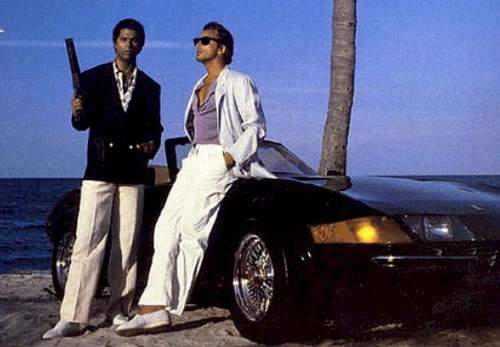
I had a nice visit with a painter yesterday whose palette includes bright yellow and orange. She told me about a young curator who commented that her work was “so 80s, like Miami Vice.” The curator saw neon and thought Don Johnson?

I can only sneer at omnipresent, kneejerk comparisons to pop culture. What ever happened to references to art history, or psychology, or just something else other than TV? Of course, viewers are free to make their own associations, as are artists. The pool is very deep. But curators should really aim to broaden and expand notions of color, form and subject. My opinion.

And why does the fashion – literally the clothes – of these same curators have to be so referential too? The mega glasses and t-shirts with outdated puns look stupid. Also my opinion.

Monday, June 21, 2010

Not with a bang, but a whimper


(Derrick Adams, The Lieutenant, 2010, 63" x 24")

And so “Out of Line” closes at the end of the week. A year in the making, my expectations were high. I had hoped for sales (none so far), a visit from Roberta (I don’t even know if she got our invitations), a new “whooohooo” opportunity. But really, this show is just another step down the long road.

The coherence of the work in the exhibition, my talk, and all the other preparations did bear fruit. We had success, both public and private (personal encouragement, some new acquaintances, the New Yorker for example). But it’s a splash of cold water in the face to learn how much an artist can’t rely on the goodwill of any potential visitors or art-world professionals once the show is up. Really, if you want to make inroads in terms of making a public name or career for yourself, you’ve got to be alpha-male aggressive, opportunistic, even over-bearing. It's a slog. I can’t say that’s my cup of tea.

But, I do want to make work still, and that’s the only reason to stay in the game.

All you need is one partner to keep going.

Wednesday, June 16, 2010

Primitivism

(Huma Bhaba, Bumps in the Road, 2008)

Along with “physicality,” the buzzword of the moment (in art of course) seems to be “primitivism.” My BFF (and we haven’t even met yet) Christian Viveros-Fauné, uses it in his article in the Voice today.

"Homunculi" [the current show at Canada] introduces largely accomplished versions of a newly popular trend toward artistic primitivism.”

This term seems to describe art that displays a rawness of expression that is reminiscent or suggestive of either “primitive” cultures – like Africa? I thought we were over that designation – or that borrows from prehistoric peoples, or that is somehow naïve or outsider. I think I prefer the term rawness or intuitive, although that might be too psychological, and not ethnographic enough, if that matters.

An artist I know said this word was used to describe the work of Huma Bhabha. I dig her.

Wednesday, June 9, 2010

What (the hell) is Modernism?

(My friend visiting Out of Line)

There are words that are slewed through art circles without a care in the world. “Conceptual” used to be my pet-peeve. If someone says your piece is conceptual, it usually means they don’t get it. To me “conceptual” means work stemming from the Conceptual Art movement in the 60s. It doesn’t mean any piece that makes you think. Let’s move on.

Distopian and ontological. I’m not that interested in exploring these terms right now.

What I want to look at today is the word “Modernism.” There was a time when “modern art” meant “of our times” (Museum of Modern Art). Now we have the word “contemporary” for that. Today “Modernism” should really mean "of the period around the early twentieth century when breaking new ground away from tradition was a primary interest." I’m pretty sure Matisse, T.S Eliot, and Cubism are considered Modernists.

Then I hear “Modernist architecture.” This seems to be the embrace of “technology” in architecture in the 40s and 50s – is that right? - ,which yielded sleek design (the Seagram Building, for example). From our present-day perspective “Modernist architecture” is really retro architecture.

But then there’s “modernism” meaning "relating to self-consciousness and subjectivity." The Abstract Expressionists are modernists, for example. With the term “post-modernism,” the idea of the self became a thing of the past, because the self was deemed impossible to define narrowly (Hey, some people are black and some people are white). But I don't think "modernist" artists are trying to peg anything, really. The approach or filter is just the individual, as I see it.

Many theory-based artists and writers seem to have disdain for strains of modernism in contemporary art (thick paint, psychological bents, the human touch) because it somehow denies that there are systems in the world. Bah. You can favor the mark of the hand and know FedEx exists.

Readers: do I have most definitions of modernism covered here in the most cursory way?

Monday, June 7, 2010

Mini gallery crawl

(Tuckery Nichols, Untitled, 2010, shoe soles and wood, 3 x 3 x 3 inches)

Can’t wait to get back into the studio. What really matters in all of this is making I think. I just wouldn’t be able to keep up full time with the rest: the networking, the emails, the thanking, the making sure this, making sure that. I’m certainly not complaining about finally being at the beginning of an art career. It’s simply that it’s a lot of paperwork! And it’s very draining at times.

To refuel, viewing art helps.

I particularly liked Tucker Nichols’ refreshing show at ZieherSmith. While it could potentially come across as faux-naïve, the work feels unguarded and playful. Down the block, Josephine Meckseper’s installation at Elizabeth Dee feels the opposite: deliberate and cool, heady and insider.

Over on 22nd Street, a small show of Paul Bloodgood’s paintings at Newman Popiashvili is big. The press release indicates Bloodgood’s interest in how painting can veer from self-expression. It’s interesting to read about (if I understood it correctly), but when I look at his work – and perhaps at art in general - , I can’t help but think it just IS self-expressive. It has a human touch and that's what I like about it. And the rest is the rest.

Wednesday, June 2, 2010

Out of Line in the press


"Out of Line" is on the Short List in this week’s New Yorker in the Goings on About Town section! Whooooo! Oh, I mean, "I am so pleased."

This Saturday I will be giving an unconventional slide-presentation that will expand on the show.

The presentation is a subjective survey of what line is and has been in visual art and other domains, including sports, war, language and spiritual practice. I travel far and wide from Matisse to Charles Ray, from my bathroom calendar to a chorus line, from vectors to the most delicate grape leaf outlined by Ellsworth Kelly.

Please come.

June 5 at 5pm.
Slag Gallery
531 West 25th St., Ground 10

Wednesday, May 26, 2010

Things to Remember

(Claude Monet, Nymphéas, 1914-1917, oil on canvas, 59 x78 3/4 in.)

1. It’s art if you think it is.
2. In making art, you carry out your own vision, not anyone else’s. It’s more personal than showing your influences and it’s beyond trend. And this is easier said than done.
3. One truly like-minded friend goes a long way. Pollock and Krasner, Guston and Coolidge, Gilbert and George.
4. Lists are simplistic.
5. If you camp out at Monet in Chelsea, you will see lots of art world peeps who don’t answer your emails.

Monday, May 24, 2010

The Morning After


(Crowd shot from the opening of Out of Line)

Some people say, “Fantastic!”, “Love the work!”, “Like the direction you’re going in!”, “Cohesive show!”. But what I dwell on, what I stick to, is the negative. And it’s not even that negative. It’s just not positive, it’s lukewarm, like, “I generally liked it,” or “that’s not my favorite piece.” It might even just be the nebulous “Congratulations.” Then I start feeling my thyroids swell, as if someone were holding me by my neck up against a wall. I’m convinced I’ve done something wrong. Something very, very wrong. And that that one nonplussed comment means the whole endeavor is a bust. That I am a bust. I could spend my whole life trying to change that opinion.

But I digress. Showing art in public is a risk. You don’t show yourself perfectly and therefore you are vulnerable. In front of everybody. But you’ve also made a move, staked a position that can make an impression on a few others, and of course on your own self. I have to say, so far, all in all, this time around, it has been really quite heartwarming.

Wednesday, May 19, 2010

Installed and Looking Good


And maybe I can return to normal blogging soon.
Hope to see you at the opening or during the run of the show.

Wednesday, May 12, 2010

Monday, May 10, 2010

Out of Line


For Immediate Release:

May 10, 2010


SLAG Gallery is pleased to announce the opening of OUT OF LINE, a group exhibition featuring work by Nils Folke Anderson, Anne-Lise Coste, Elana Herzog, Carin Riley and Molly Stevens, who is also the curator.


May 20 – June 19, 2010

Opening Reception: May 20, 6 – 8 pm

Artist’s Talk by Molly Stevens: June 5, 5PM


The conventional concept of line in visual art is bound to drawing on paper. In this exhibition, however, line is a presence, visible in movement and space, paint and electricity, language and metaphor. OUT OF LINE is a fresh look at a variety of line forms: fresh, meaning vigorous and immediate, but also meaning bold and cheeky. OUT OF LINE takes a risk and speaks its own mind.


Carin Riley
’s large-scale paintings from 2010 are the visual confluence of a personal vocabulary of images. Seemingly disparate elements cohere around fluid line work and a metaphorical logic that struts a bold attitude away from linear narrative.


Anne-Lise Coste’s tarpaper scroll from 2009 is a bilingual stream of consciousness that is at once frenzied and hilarious. Line is text but also the loopy marks that form handwritten letters and words.


Elana Herzog’s effortless curtain from 1992 is at once mysterious and plain-faced, solid and delicate, decadent and frayed and, as such, reminds us that lines are not easily drawn. While the piece nods to Surrealism - and also to the Renaissance - it announces the artist’s rich involvement with textiles.


The electric lines of Nils Folke Anderson’s 2009 interlocking neon are bounded by form and released by light. This vibrant orderly disorder provides a model for the show as a whole.


In Molly Stevens’ surging and cockeyed mountains from 2009 and 2010, long currents rise up and down the page, lean into each other and draw apart to form vibrating and off-kilter landscapes.


On June 5 at 5pm, Stevens will present an artist’s talk called “Out of Line,” a subjective survey of what line is and has been in visual art and other domains, including sports, war, language and spiritual practice. The event is open to the public and is free of charge.


Donkey Trail, a year-long blog of thoughts, images and interviews leading to this show, can be viewed at the desk or online at: trailofadonkey.blogspot.com.


SLAG Gallery specializes in contemporary American and Eastern European art and is operated by owner and director Irina Protopopescu.


SLAG Gallery is located at 531 West 25th Street, Ground Floor, suite 10.

(Between 10th and 11th Avenues).

Hours: Tuesday through Saturday, 11 am to 6 pm.


For press inquiries and reproductions contact Irina Protopopescu, 917 977 1848.

For general inquiries, contact the gallery at 212 967 9818.
Wednesday, April 28, 2010

Facts are not feelings


(Qu Ding, Summer Mountains, handscroll, Norther Song Dynasty (960-1127)

If I feel miserable about the way a drawing is coming out, it does not mean the drawing will have a miserable look. If I feel sloppy, it may not look sloppy. And if I feel like it sucks, the drawing may not suck. Facts are not feelings. That still rings true for me.

I’ve tended to think that a drawing will show the state of the artist while making that drawing. In many ways it does. A tense hand will usually make a tense line. But being aware of one’s state and controlling one’s state, doesn’t mean the drawing is aware or controlled. Drawings can mean and point to many things beyond what we’re conscious of. And sometimes they don’t.